
Discover the stories behind our projects on our blog.
Learn who we are, our vision, and the design philosophy that shapes every space at Adib Architects.
design story n.1
Mosque of Suspended Dome
10 january, 2024
How Do We Design the House of God?
Between Spirit and Architecture
Designing a mosque today is a profound challenge for any architect; a mosque is not merely a building, but the House of God. From this comes the essential question: how can a space make you feel you are in the presence of God?
The Muslim architect of the past succeeded in shaping the spirit of place, transforming Islamic meanings into living architecture, where every line and form carried a message and a meaning that we still experience today. They possessed deep insight into the psychological and emotional impact of space, an ability many contemporary architects have lost.
Today, however, the race for hybrid forms has even reached mosques, leaving many of them devoid of soul. Architects of our time have abandoned a timeless heritage that transcended centuries: an architecture that stirs the senses, awakens contemplation, and reflects the spirit and values of the believer. Instead, they have replaced it with transient models that leave no trace today, so how will they become a legacy for tomorrow?
From here we assumed the responsibility of restoring essence: spirit and serenity. We worked on transforming this vision into an architectural model that reflects our thoughts and values. We created poetic spaces that speak to the senses and move the human being from within, spaces where the worshipper experiences the transition from the material realm to the sacred one. The mosque may appear simple, yet it holds depth and meaning within.
The Mosque: A Link Between Earth and Heaven
Traditional mosque architecture was built upon clear symbolism: the square represents the earth with its four directions, the dome symbolizes the heavens, and between them lies the prayer hall, preceded by a courtyard and an entrance.
Accordingly, the design of The Hanging Dome Mosque is composed of three equal squares:
The Courtyard (Sahn): representing the material world, the prayer hall: representing the spiritual world, and the Water Court: symbolizing eternal life.
We employed concrete as the sole material, chosen to express purity and simplicity, free of ornamentation and excess, where, in the Islamic sense, spirit outweighs matter. Light and shadow were used alongside precise proportions to achieve beauty and the intended impact of space and openings.
The Worshipper’s Journey
The journey begins with a descent into the courtyard, an act of humility and gradual separation from the material world. Here, the spiritual path opens with ablution at the central fountain. Natural light serves as a guide, subtly accompanying each step.
At the threshold of the prayer hall, light filters in with a mystical quality, reaching its climax at noon when vertical sunrays pierce the entrance, announcing the sacred hour of prayer.
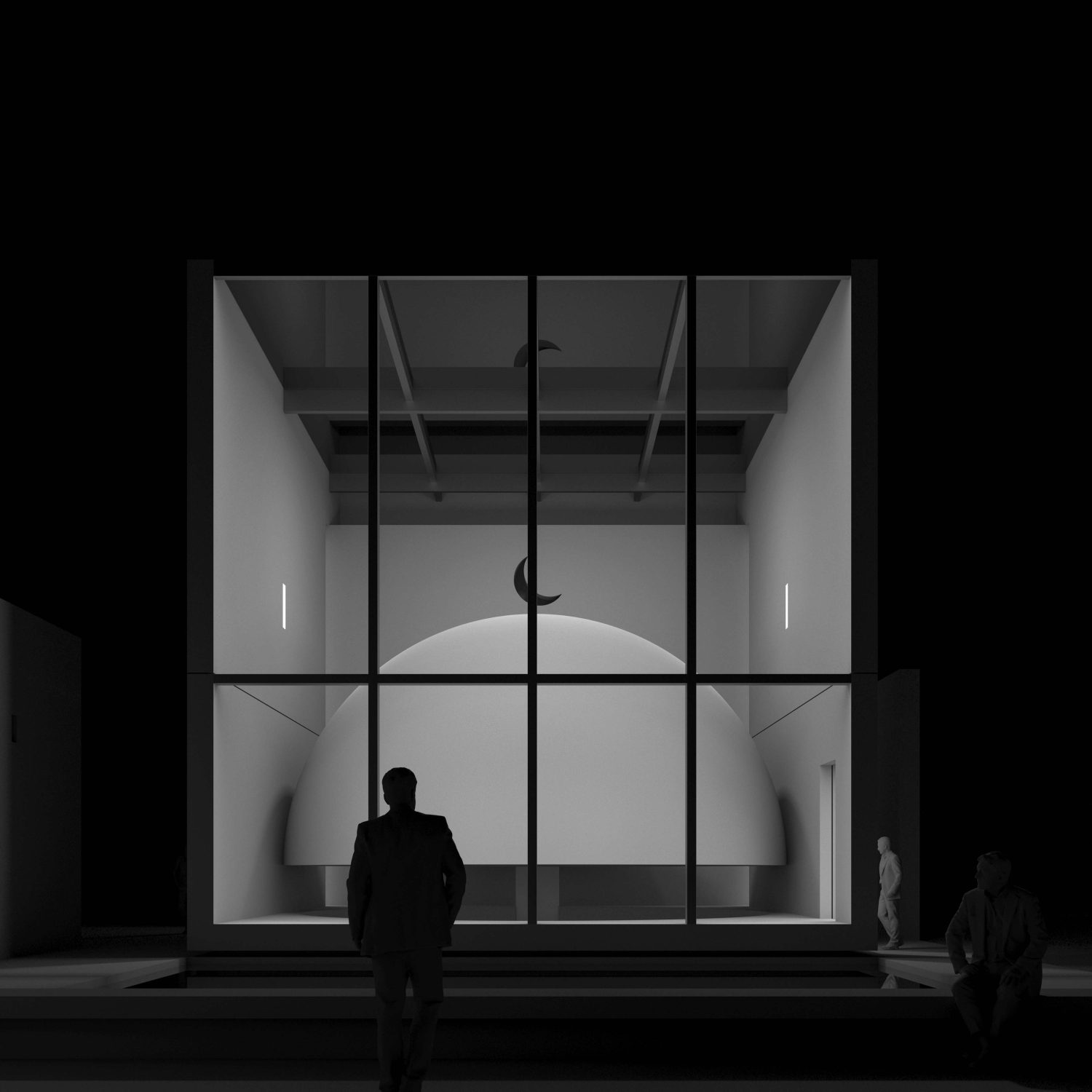
Inside the prayer hall, the worshipper stands within a cube crowned by a suspended concrete dome. Light seeps between the two, mediating between the material and the spiritual. At the dome’s apex opens the “Gate of Heaven”, a circular opening that allows light to stream from above. The enclosing concrete walls isolate from the outside world, focusing perception and spirit toward light and meaning.
After prayer, one steps out to contemplate the poetic scene of the suspended dome, its presence shifting with time and seasons, leaving behind a lasting mental image, a profound memory carried long after the experience has ended.
At night, the mosque transforms into a dialogue between light and shadow. The suspended dome, softly illuminated, seems to hover within the cubic volume, its edge tracing a faint glow against the darkness. The geometry recalls the cosmos, where a luminous horizon emerges from infinite night. In this space, the dome becomes both architecture and sky, a constructed firmament contained within the cube.